
Project Brief:
The assignment required the class to create an alternative solution to non-emergency 911 calls. The class was to design a porotype iOS application, that follows Apples guidelines and standards. The class was first to create a: proposal, competitive analysis, flow chart, design, slide deck and then working porotype of the application.
After learning about inclusive design and user accessibility, students were to redesign an existing app and to make it more accessible for all users who will be using the application.
Project Proposal
It is estimated that nearly 240 calls in America are made to 911 each year (2021, Nena). However when a person is in need of assistance from the government, the default design of the 911-control center sends armed law enforcement to the caller’s location even if the situation is not an emergency. Due to the fact that if ones call is not an emergency, the officer being dispatched might not be able to respond to the issue right away. There must be an easier way that helps people in need of non-emergency issues, to quickly and efficiently get their problems solved. One of the non-emergency issues that I believe is in need of redesign work is developing noise complain ordinances. All Communities in each state of the U.S need a quick and efficient way of measuring sound decibels of the noise they are concerned with, so that law enforcement can process there ordinances and take care of the noise violation in a quick and effective manner. It can be difficult for communities that are unaware of how the noise violation ordinances work, to obtain all the correct documentation that law enforcement needs in order to process the forums. Average citizens of America most likely will not know what the decibel requirement is that justifies as a noise violation, in their specific community. The decibel sound requirement that justifies legal actions can differ, for each individual county. This can make it harder for communities to obtain all the correct information they will need when filling out the noise violation ordinances. As well some of these ordinances can be vague with non-descriptive notes of the specific sound levels. This makes it more challenging for the officers to obtain the correct information that they need in order to process these ordinances (2021, KNC). Communities need a faster and more reliable noise violation ordinances, so that their requests can be processed quickly.
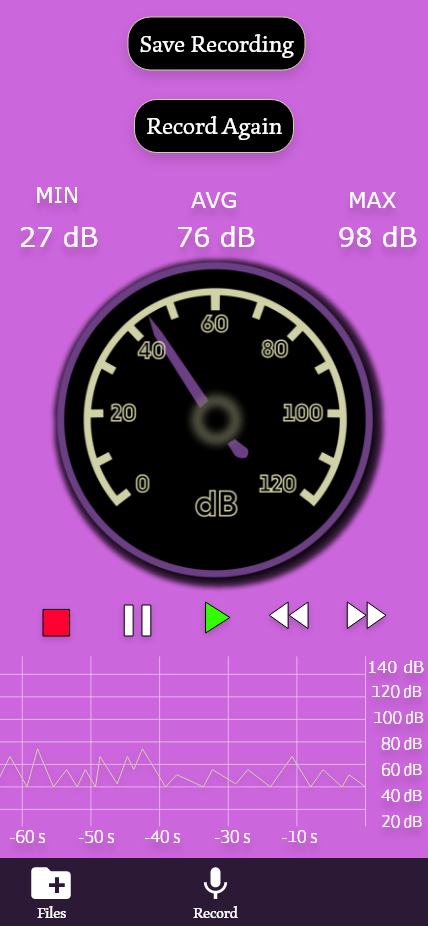
To help solve this issue I am developing an application that can determine the sound levels of the user’s environment and organizes the documents needed to create these ordinances in a quick and easy way. The user will be able to use the speaker on their smart phone to determine the sound decibels of the noise and the software will determine the levels frequency. There are three levels to the noise detection. The first level is color coded as green, letting the user know that the noise level does not require any legal actions. The user can still process the noise violation forums, but the legal actions depend on the users state laws. The second level is color coded as yellow, letting the user know if the sound levels starts to increase legal actions will be needed. The third level is color coded as red, letting the user know that legal actions will be needed. The application will then guide the user through the process of creating the legal forums needed for these ordinances. After the user fills out the ordinances it will then be processed by law enforcement, so that they can quickly take care of the noise violation. Communities in America deserve environments they feel comfortable in. My goal for this is to create software that allows them to quickly document the noise levels around them and to guide them through the legal documentation that needs to be processed.
Explain how inclusive design and accessibility are related?
Inclusive Design and accessibility both focus on designing for everyone and work on new ideas and designs that will work for people who have disabilities who use special functions to navigate apps, websites, media, etc. They both are intended to help people with disabilities use the design/device the designer is creating (2020). The designer for both accessibility and inclusive design is supposed to get out of their own shoes and see the design they are creating through the lenses of certain individuals with disabilities or aliments and to see what a new approach to the design they are creating could work for the disabled as well as everyone else.
The way that these two methods are different is that inclusive design is a methodology to the approach of the design whereas accessibility is more about the outcome of the design (2014). Inclusive design is the process of creating designs that work for an array of people and is more about the methods that will work for a diverse group of people. accessibility is geared towards more of the outcome and the end results of the design (2019). It focuses on guidelines and certain legal requirements that companies enforce for the products they sell such as the size of the text, colors, and many more design requirements. It is attended to be used so that no one is left out to use the designer’s website, app, streaming service, etc.
Design Process
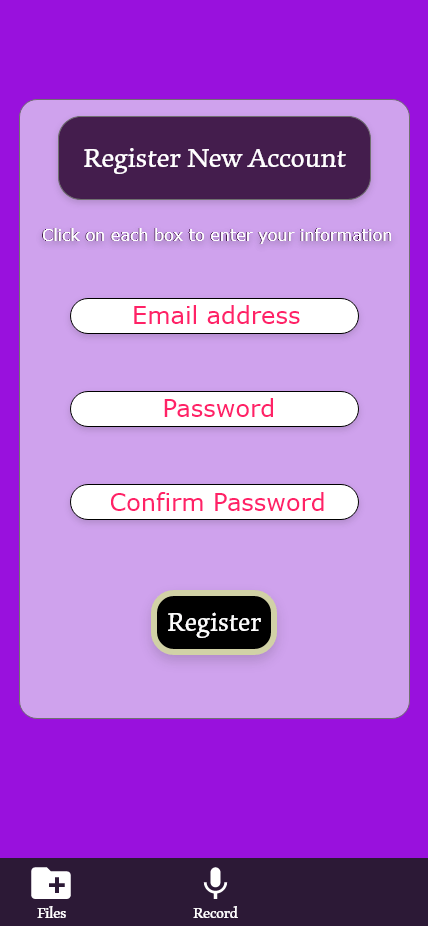
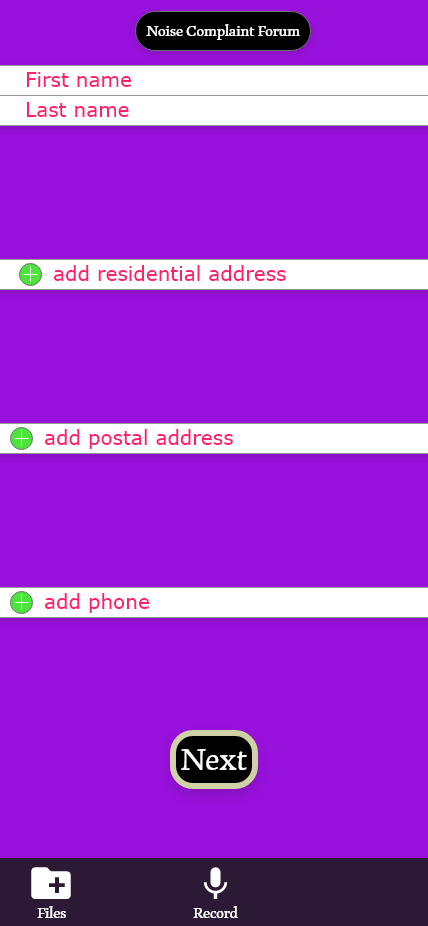
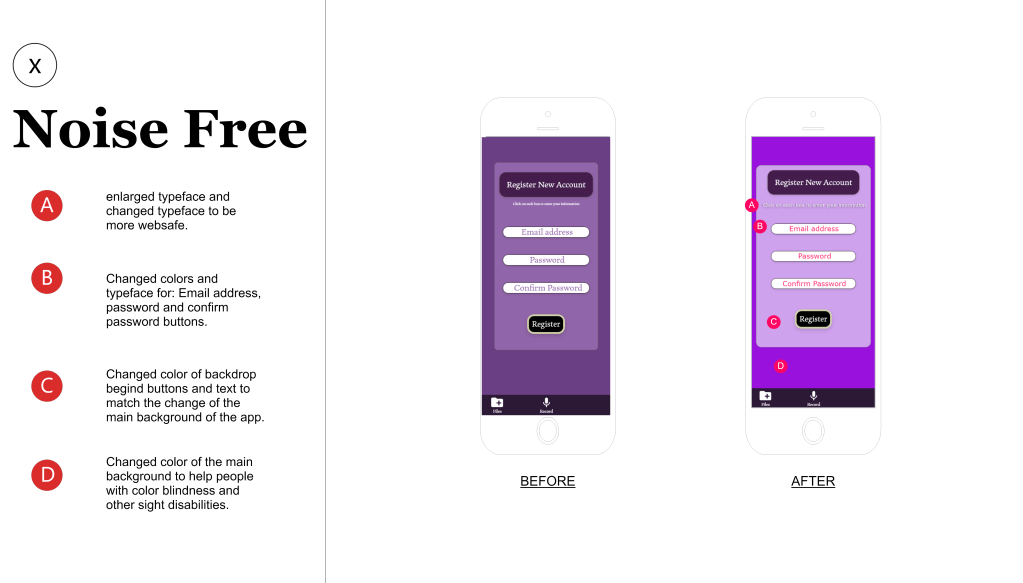
When looking back at the first app I created in Interactive Media, I noticed that a lot of the text and colors I used might be hard for people with sight issues/disabilities to read. To solve this issue I redesigned the fonts, colors, Icons, etc. and changed it to make it more accessible for all users that will be using the app.
I used Adobe XD to recreate the images from my previous app and used colors and fonts that follows the accessibility guidelines so that people with sight disabilities or that of an older age will be able to read the fonts icons and buttons that are on my application.
After redesigning and exploring the new ways of creating for all, I began to step back and try to see my design through a new lense instead my own personal vision. When doing this I realized that designing for all not only helps certain people with disabilities to able to read my newly created text, colors and fonts, but in general it made the design a lot more legible and coherent.
(Before) Screen Individual Images

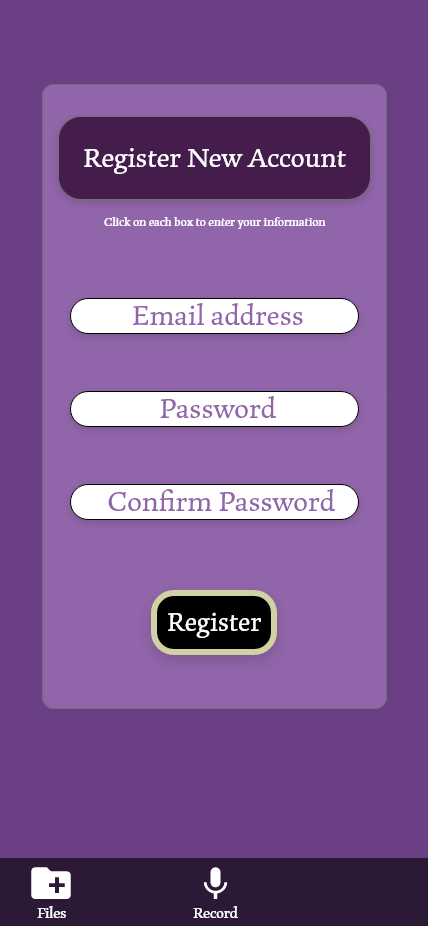
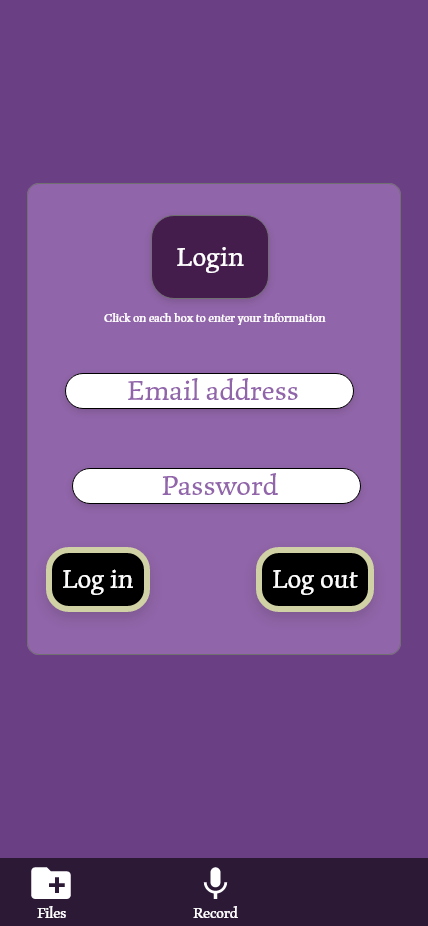

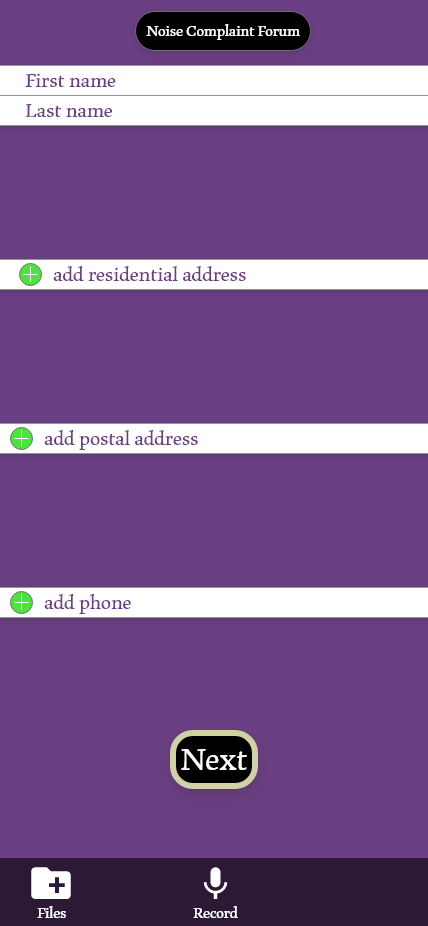

(After) Screen Individual Images



Before & After Slide Deck

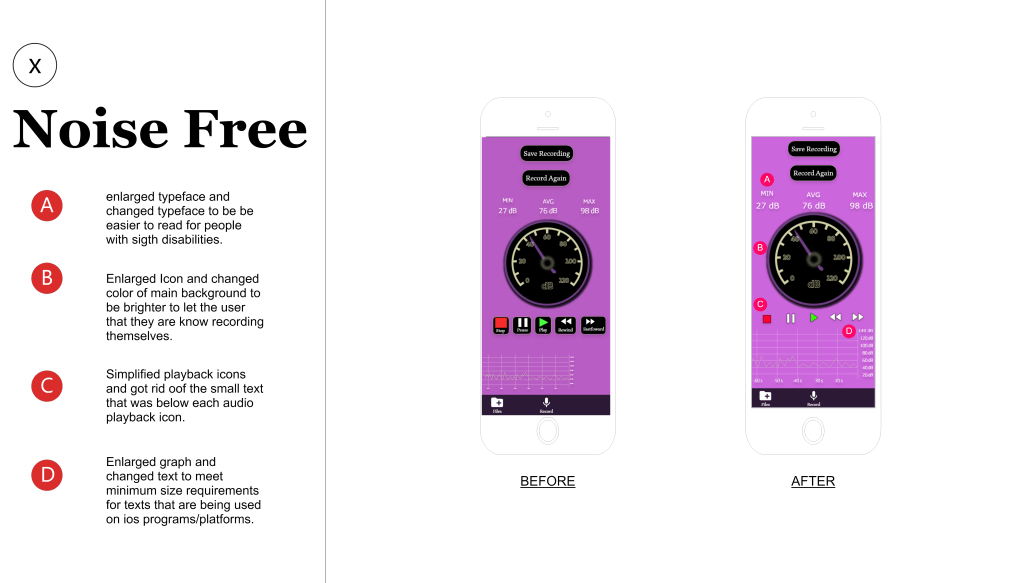


Work Cited:
KNC. (2021). Noise ordinances. Kinetic Noise Control. https://kineticsnoise.com/industrial/noise_ordinance.html (Links to an external site.)
Nena. (2021). 9-1-1 Statistics. Nena The 911 Association. https://www.nena.org/page/911Statistics
Chapman, C. (2020, April 15). Accessible design vs. Inclusive Design (with infographic). Toptal Design Blog. Retrieved April 20, 2022, from https://www.toptal.com/designers/ui/inclusive-design-infographi
Gilbert. (2019). Inclusive Design for a Digital World, Designing with accessibility in mind, 14-15
https://doi.org/10.1007/978-1-4842-5016-7
Persson, H., Åhman, H., Yngling, A. A., & Gulliksen, J. (2014). Universal design, inclusive design, accessible design, design for all: Different concepts—one goal? on the concept of accessibility—historical, methodological and philosophical aspects. Universal Access in the Information Society, 14(4), 505–526. https://doi.org/10.1007/s10209-014-0358-z
 Alex Lind